

So you’ve been hitting your chest with 3 sets of bench press, 3 sets of incline press, and 3 sets of flyes every workout, but you’re not sure if that’s the optimal amount of sets for chest growth.
You might be wondering if more sets could lead to better gains, or if you’re actually doing too much.
How many sets per workout is ideal for maximizing chest development?
Let’s explore the science behind set volume and its impact on chest training to help you make the best decision for your fitness journey.
Table of Contents

Related Video: "How Many Sets Do You Really Need to Build Muscle?" by Jeremy Ethier
Main Points
– Increasing set volume in chest training can stimulate more muscle fibers, promote greater muscle growth, and enhance metabolic stress and mechanical tension.
– Individual strength levels, recovery capacity, training frequency, and intensity of workouts all play a role in determining optimal set requirements for chest training.
– The effective set range for chest growth is 12-20 sets per week, divided over 3-5 workouts. Starting at the lower end of the range is recommended.
– Balancing frequency and intensity is crucial to avoid compromising recovery, listening to the body, gradually increasing frequency, and incorporating exercise variation to prevent overuse injuries.
Benefits of Increasing Set Volume

By increasing the number of sets in your chest training workouts, you can effectively stimulate more muscle fibers and promote greater muscle growth. Typically, aiming for 3-4 chest exercises per workout and performing 3-4 sets for each exercise can yield significant benefits. Increasing the sets for chest per workout allows for a higher overall training volume, which is a key driver for muscle hypertrophy. This means that by incorporating more sets into your chest training, you’re providing a greater stimulus for muscle growth.
Additionally, higher set volumes can lead to increased metabolic stress and mechanical tension on the muscles, both of which are crucial for maximizing muscle growth. However, it’s important to maintain proper form and avoid overtraining when increasing set volume.
Factors Affecting Set Requirements

Understanding your individual strength levels and recovery capacity is crucial in determining the optimal set requirements for your chest training.
Your strength levels play a significant role in determining how many sets you need. If you’re relatively new to weight training, you may require fewer sets to stimulate muscle growth compared to someone with more experience and higher strength levels.
Additionally, your recovery capacity is essential to consider. If you find that your chest muscles are slow to recover after a high volume workout, you may need to reduce the number of sets to allow for adequate recovery. On the other hand, if you recover quickly, you may be able to handle a higher set volume.
Furthermore, your overall training frequency and the intensity of your workouts will also impact the number of sets you should perform. By understanding these factors and paying attention to how your body responds, you can adjust your set requirements to optimize your chest training and achieve the best results.
Optimal Sets for Chest Growth

You need to understand the impact of set volume on chest growth and the effective range of sets for optimal results.
It’s important to consider how many sets you should be doing in your chest workouts and what range is most effective for muscle growth.
Set Volume Impact
To achieve optimal chest growth, focus on the impact of set volume and its role in your workout routine.
– The number of sets you perform directly influences muscle growth and strength gains.
– Higher set volumes can lead to greater muscle damage and metabolic stress, promoting hypertrophy.
– However, excessively high set volumes may lead to overtraining, hindering progress and increasing the risk of injury.
– It’s essential to find the right balance of set volume that challenges your muscles without overwhelming them.
Effective Set Range
Considering the impact of set volume on chest growth, aiming for an optimal set range can significantly enhance your workout results.
For effective chest growth, targeting a set range of 12-20 sets per week, divided over 3-5 workouts, has shown promising results. This set range allows you to stimulate muscle growth without overtaxing your chest muscles.
It’s important to note that individual response to set volume may vary, so it’s recommended to start at the lower end of the range and gradually increase as needed.
By staying within this optimal set range, you can effectively challenge your chest muscles and promote growth while minimizing the risk of overtraining.
Keep in mind that the quality of each set is crucial, so focus on maintaining proper form and exerting maximal effort within each set.
Balancing Frequency and Intensity

Balancing frequency and intensity in your chest training workouts is crucial for achieving optimal results and preventing overtraining. Finding the right balance between how often you train your chest and the level of intensity you incorporate into your workouts is key to maximizing muscle growth and strength gains.
When considering frequency and intensity in your chest training, keep the following in mind:
– Frequency: Determine how often you can effectively train your chest without compromising recovery. Factors such as age, fitness level, and overall training volume will impact your ideal training frequency.
– Listen to your body: Pay attention to how your chest muscles respond to training and adjust your frequency based on recovery and soreness.
– Progressive overload: Increase your training frequency gradually over time to allow your chest muscles to adapt and grow stronger without becoming overworked.
– Variation: Incorporate different chest exercises and training modalities to prevent overuse injuries and stimulate continuous muscle growth.
Overtraining and Set Limits

You need to understand the importance of setting volume limits and avoiding overtraining when it comes to chest training.
It’s crucial to find the balance between pushing yourself and preventing burnout.
Set Volume Limits
When determining set volume limits for your chest training, it’s important to avoid overtraining and set limits to ensure optimal progress and recovery. Here are some key points to consider:
– Listen to your body: Pay attention to signs of overtraining such as persistent fatigue, decreased performance, and increased irritability.
– Adjust accordingly: If you experience these symptoms, consider reducing your set volume or taking an extra day of rest to allow for adequate recovery.
– Gradual progression: Increase your set volume gradually over time to prevent sudden spikes in training stress that could lead to overtraining.
– Monitor closely: Keep track of your sets, reps, and overall training volume to ensure you’re progressively overloading without exceeding your body’s capacity.
– Recovery strategies: Incorporate effective recovery strategies such as sufficient sleep, proper nutrition, and active rest days to support your chest training and prevent overtraining.
Avoiding Overtraining
To maintain optimal progress and recovery in your chest training, it’s crucial to avoid overtraining by setting limits on your set volume.
Overtraining occurs when you push your body beyond its capacity to recover, leading to decreased performance and increased risk of injury.
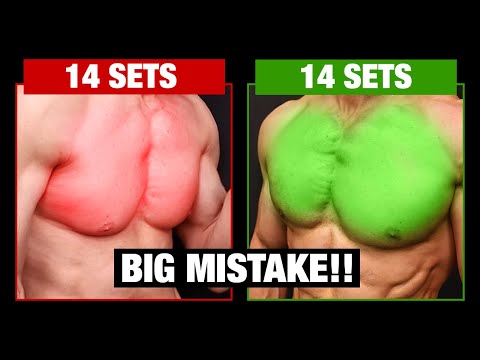
Related Video 2: "“How Many Sets Per Week for a BIG Chest” (SCIENCE SAYS!)" by ATHLEAN-X™
By establishing set limits, you ensure that you’re challenging your muscles effectively without overburdening them.
Aim to strike a balance between pushing your limits and allowing for adequate recovery.
It’s recommended to cap your chest training sets at around 12-20 working sets per week, depending on your training experience and individual recovery capacity.
Pay attention to your body’s signals, such as excessive fatigue, persistent soreness, and decreased performance, as these may indicate overtraining.
Optimal Training Frequency
How frequently should you train your chest to avoid overtraining and set sensible limits for optimal progress and recovery?
It’s crucial to find the right balance to prevent overtraining and maximize gains. Consider these factors when determining your optimal training frequency:
– Listen to your body: Pay attention to how your chest muscles feel after each workout. If you still feel fatigued or sore, you may need more recovery time.
– Set realistic limits: Avoid the temptation to train your chest too frequently. Overtraining can lead to decreased performance and increase the risk of injury.
– Gradually increase frequency: Start with a moderate training frequency and gradually increase it as your strength and endurance improve. This approach allows your body to adapt while minimizing the risk of overtraining.
Progressive Set Strategies

Maximize your chest training by implementing progressive set strategies to continuously challenge and stimulate your muscles for optimal growth.
Progressive set strategies involve manipulating variables such as weight, reps, and rest periods to push your muscles beyond their current capabilities.
One effective strategy is the pyramid sets, where you gradually increase the weight and decrease the reps with each set. This helps to recruit different muscle fibers and induce greater muscle fatigue.
Another approach is drop sets, where you perform an exercise to failure, then quickly reduce the weight and continue for additional reps to fully exhaust the muscle.
Utilizing supersets, which involve performing two exercises back-to-back with minimal rest, can also enhance muscle stimulation and efficiency.
Finally, incorporating rest-pause sets, where you briefly pause during a set to extend the total reps, can further challenge your muscles and promote hypertrophy.
Advanced Set Variation Techniques

You can enhance your chest training by incorporating advanced set variation techniques to continually challenge and stimulate your muscles for maximal growth. These techniques can help you break through plateaus and keep your workouts exciting and effective.
Here are three advanced set variation techniques to consider:
– Drop Sets: Start with a heavy weight for an exercise and perform as many reps as possible. Once you reach failure, immediately reduce the weight and continue the set. This intensity technique pushes your muscles to their limits, promoting muscle hypertrophy and endurance.
– Supersets: Pair two exercises together and perform them back to back with minimal rest in between. This technique increases the intensity of your workout, allowing you to target different areas of the chest and keep your heart rate elevated for added cardiovascular benefits.
– Paused Reps: During an exercise, pause for a few seconds at the most challenging point of the movement. This technique increases time under tension, leading to greater muscle fiber recruitment and growth.
Incorporating these advanced set variation techniques into your chest training can provide the stimulus needed to spur new muscle growth and development.
Individualized Set Recommendations

Consider tailoring your set recommendations to your individual fitness level and goals for optimal chest training results. Whether you’re a beginner aiming to build a foundation, an intermediate looking to increase strength, or an advanced lifter striving for muscle hypertrophy, customizing your set volume can significantly impact your progress. Here’s a breakdown of individualized set recommendations based on your fitness level and goals:
| Fitness Level | Strength Goal | Hypertrophy Goal |
|---|---|---|
| Beginner | 3-4 sets | 3-4 sets |
| Intermediate | 4-5 sets | 4-5 sets |
| Advanced | 5-6 sets | 5-6 sets |
Frequently Asked Questions
What Are Some Common Signs of Overtraining When It Comes to Chest Workouts?
Feeling persistent soreness, a decrease in performance, or struggling to bounce back after workouts are common signs of overtraining. You might also notice increased irritability, trouble sleeping, or a higher resting heart rate.Pay attention to these signs, as they could indicate that your chest workouts are pushing you too hard. It's important to listen to your body and give it the rest it needs to recover properly.
Are There Any Specific Chest Exercises That Benefit More From Increased Set Volume?
For chest exercises, some benefit more from increased set volume. For example, incline bench press and chest flyes can benefit from higher set volume to target different areas of the chest. Increasing sets can add more time under tension and challenge your chest muscles in different ways.Remember to listen to your body and gradually increase the volume to avoid overtraining. Always prioritize proper form and muscle engagement over sheer number of sets.


